Monday, April 25, 2016

Notetaking - What Do I Write...errr..Type in My Notebook?

During my brief stint in law school, note taking was often a frustrating proposition. Professors were committed to a Socratic method of questioning, and rarely, if ever, gave definitive answers. Finally, midway through the year, one of my first year law classmates threw down her notebook in class and said "What the hell am I supposed to write in my notebook?", left the class, and never returned. Even accomplished students grapple with the best system for note taking.

This morning the topic of note taking came up in department meetings, and recently there has been much discussion regarding handwritten notes vs. typewritten notes (on a laptop or device). The journal Psychological Science recently published research indicating that recall is better when notes are taken by hand than when kept via a keyboarding system. The cognitive process one goes through to evaluate spoken words and form associations and abbreviations seems to engage the mind in a way that typing notes verbatim does not accomplish. The study compared recall results of two groups after listening to a series of TED talk lectures on information that was of interest, but not widely or generally known. One group took notes by hand with paper and pen, while the other used keyboards to keep typewritten notes. The paper and pen group performed better, leading to a conclusion that this method might be the better choice for students. (http://www.psychologicalscience.org/index.php/news/releases/take-notes-by-hand-for-better-long-term-comprehension.html)  Interestingly, the study did not consider a third group of students who took no notes but sat and listened. Some researchers believe in the “Distraction Hypothesis”, which posits that the act of taking notes is a distraction and that people are better off engaging in active listening. There does not seem to be any conclusive evidence that this is so.

In terms of implications for our students, the question then arises as to whether we should mandate a particular approach to taking notes, or conversely, “outlaw” typewritten notes. Like all learning preferences, it’s important that students find the method that works for them. Learning is not a “one size fits all” proposition, and students finding an organizational method that works for them is more important than the methodology they employ. There are certainly some benefits of typewritten notes – digitally stored notes are easily searchable, can be cut and pasted, can easily include images, charts and graphs, and can be taken via a web-based platform such as Evernote so that they are accessible from any internet enabled device. Conversely, typewritten notes are significantly less effective in areas such as math and science that might include symbols and shapes that are difficult to replicate digitally. Perhaps the best “hybrid” option is taking handwritten notes with a stylus on a tablet or touch screen device. These notes can be stored electronically, can be uploaded into applications like Evernote which use recognition software to convert them to typed format, or to make them searchable, and images can be captured easily and included with notes. After looking at this research, this is a method I’m going to try, and I encourage everyone to consider all of the possible options to maximize note taking efficiency.

The research published in Psychological Science and conducted by Princeton and UCLA researchers doesn’t explicitly recommend that students never use keyboards to take notes. Blogger Daniele Walker writes, "This research by Princeton and UCLA does not suggest that students should never use keyboards to take notes. Rather, it warns against transcribing lectures verbatim rather than closely listening as the pitfall of electronic notes. This, they say, is what causes digital notes to slip through the cracks of students’ brains. The experimenters explicitly told typists not to transcribe lectures verbatim, with almost no luck. “ (http://www.ecnmag.com/blog/2014/02/digital-or-handwritten-note-taking-debate). Perhaps the issue is more how we teach students to take notes (or perhaps how we don’t), it’s a topic of great interest and importance to our students.

There are a lot of great note taking systems out there. For example, for those of you unfamiliar with the Cornell note taking system, here is an example of an outstanding model http://lsc.cornell.edu/wp-content/uploads/2015/10/Cornell-Note_Taking-System.pdf. Regardless of the mechanism used for taking notes, the organizational and study skill pedagogies are perhaps most important.

Like most things we do, the practice of note taking, and the tips and instructions we give, can stand some examination. Not all notes are equal, and not all methods return the desired results. Perhaps most important is knowing what to write, or type, in our notebooks...

Monday, May 11, 2015

Senioritis, Project Learning, and What They Have in Common...

Today marked the first day of what we call "senior project", or "project", at Detroit Country Day School. Each of our seniors seeks and finds a job shadowing type "project" experience with a professional / expert in fields of interest, and spends the next several weeks immersed in a work environment. It really is the ultimate example of a "project learning" experience as students have the opportunity to see first hand the application of the many lessons, academic and otherwise, that have been part of their experience at Detroit Country Day School. These projects will culminate with a "fair" style day on June 8th, during which our seniors will present their experiences to an audience of parents, faculty, fellow students, project hosts, and community members.

"Senioritis" is the term often used to refer to the kind of itch seniors have to leave high school. It sets in at different times for different people, but generally, sometime after first semester exams seniors at every high school across the country exhibit symptoms. Students care less about homework, grades and school, and more about what lies ahead - and that's natural. This itch to explore, to see the world, and to know what's beyond the cocoon of high school is a natural evolution. Senior project represents a safe, protected way to allow our students an immersion experience in the "real world".

Project can go many different ways. Some students come away with an experience that completely validates everything they thought they wanted in life after high school. Some students go on project, and are immediately disillusioned with what they find the real world application of their chosen area of interest to be. Other students go on project, discover that what they thought they wanted to pursue was not quite right, but then find something tangential that does fit their interests and aptitude. 

"Project Based Learning" or "PBL" is a buzz phrase and approach in education today, and like many acronyms or ideas, it begins to lose meaning when deconstructed. Still, the process of discovery, prototyping and refining is at the core of almost every truly valuable learning experience. Through our senior project experience, many of our students gain the opportunity to explore that was missing in the confines of a classroom. Each year seniors will say that project was the best experience of their high school career.

Students don't need to be seniors to be immersed in lessons of the world outside of school. In fact, those lessons are perhaps even more meaningful than some of the lessons of the classroom. Senior project, its success, and its impact on our seniors should teach us that implementing immersion / project experiences is valuable. When we can control these experiences, and create a safe framework for exploration, project experiences are incredibly powerful.

Please join us on June 8th from 6:00 p.m. - 8:00 p.m. at the Upper School to see our senior projects on display, and to spend time with and talk to the amazing graduates of the Class of 2015. You will be impressed, and more importantly, you will be part of their learning experience as they relate their adventures putting into application that which they have learned, and "scratching the itch" of their senioritis...

Friday, January 16, 2015

Matadors

"There are many people who think they want to be matadors, only to find themselves in the ring with two thousand pounds of bull bearing down on them, and then discover what they really wanted was to wear tight pants and hear the crowd roar." - Terry Pearce

Leadership is not an easy thing. There as many different theories regarding leadership as there are leaders and organizations, maybe more. In educational strategic plans, mission and vision statements, and character education curricula, there is significant focus on the role of schools in developing "leaders of tomorrow". Clearly defining the elements of great leadership is not easy, because there are many successful and different ways to lead. Not unlike the classic Justice Potter Stewart definition of obscenity, "...I know it when I see it..." (Jacobellis v. Ohio, 1964), great leadership is often in the eye of the beholder.

The other night my 8th grade daughter had a homework assignment to interview an adult regarding World War II. Apparently my inability to take an in-focus selfie has led her to believe that I might be old enough to have memory of life in the forties, so I became the subject of her interview. One of the questions was "Do you think Adolf Hitler was a great leader?". Now, by many definitions of leadership, one might characterize Hitler as a successful leader. He was enormously successful in gaining followers, and in crafting a horrific plan, but the objectives of his leadership were so heinous that the negative implications of his leadership far outweigh the successes of his efforts. In assisting students to develop leadership qualities, it's important that we emphasize not just processes, qualities and procedures of leadership, but philosophies and development of an individual moral compass.

Paul "Bear" Bryant once said that "Good leaders take more than their share of the blame, and less than their share of the credit." At Detroit Country Day School we place an emphasis on learning to be part of a team. Every student plays interscholastic athletics and / or participates in an extracurricular team environment such as robotics, yearbook, newspaper, theater etc. These experiences are invaluable. Collaborative work environments are not the exception in the 21st century, they are the norm. Students who leave here with experiences in sacrificing for others and working towards a greater group good have an advantage over those who don't learn those lessons at a young age. Rarely is a leader more valued than when he or she recognizes the efforts of the team in securing positive results. Giving and sharing credit to teammates is an essential core competency of leadership. 

Finally, one of the most important lessons for our students is that "wearing the shiny pants" doesn't make one a leader. Leaders have to have strength of character, perseverance, and thick skin. They have to be willing to do whatever it takes for the team's success, even when that is not personally easy. One of my former mentors was fond of saying "If no one's mad at you, you probably haven't made any decisions recently." The point is that if there were no decisions to be made, there would be no need for leaders. Leaders who have developed a team first attitude, who put the success of the team ahead of their personal needs, who give credit, and who have developed a strong philosophical approach and individual moral compass will most often make the right call - even with 2000 lbs. of bull heading their way! 

Of all the things we teach, putting students in positions to grow as leaders, and developing the competencies that make one successful as a member of a team, may be the most important. As for the would be matadors, it's important to remember that some days, no matter how hard we work, the bull can get the best of us. We have to learn to fail in order to lead. Learning to minimize damage, dust ourselves off, and come back for more is an essential part of developing leadership skills. Leaders have to be willing to fight for those things that are meaningful, and be willing to fail occasionally along the way. Those skills are great skills to impart to our children.

Mostly, we have to teach our future leaders that to hear the roar of the crowd, they're going to face a lot of bull...

"Keep your fears to yourself, but share your courage with others." Robert Louis Stevenson


Wednesday, December 10, 2014

Winds of....Evolution

Somewhere along the way, "change" became a dirty word. In American school culture, the structure of which has remained mainly the same over the past fifty to sixty years, change is almost sacrilege. Perhaps the negative connotation of "change" is due to its inherently being instituted, as opposed to developing organically. Perhaps a more appropriate term for what must take place in schools is evolution.

Evolution is generally accepted as change that occurs over time, moving unseen like the hands of a clock, and represented by survival of the fittest organisms or ideas. In the world of education, that evolution has begun to occur exponentially in response to a rapidly evolving world. The rate of evolution in today's digital age is, at times, astonishing. Schools focus on trying to keep up, when instead, the goal of education should be to jump ahead.

It's not practical to think that schools can keep up with the rate of evolution occurring in technology, or even society, today. What is incumbent upon us as educators, is to give our students the fundamental skills needed to function in a variety of change / evolving environments, and then give them practice applying those skills to unique and unfamiliar problems.

I recently went with a group of students to see the movie Interstellar. It's a fascinating film in many different ways, but what really occurred to me in the context of this "science-fictiony" film was to question whether the science of the movie was realistic. Is it theoretically possible to travel through time and space by bending time? Is it theoretically possible that there are multiple dimensions that exist simultaneously? In order to answer these questions, one would need not only a fundamental knowledge of mathematics and physics, but an incredibly creative / adaptive mind, suitable for applying those fundamental skills to complex questions. Beyond the science of the movie, are the sociological, ethical, and philosophical questions. As the world evolves, the level of complexity of these issues grows.

As schools evolve, we will have to grapple with what level of fundamental skill is appropriate, and whether those skills have to be acquired in traditional ways, or can be acquired along the way in experiential, participatory learning models. Balance in all things is important, and certainly the balance between skill, content, and adaptation is a delicate one. Preparing our students for college, and for the world beyond college requires that we have taught them to be ahead of evolutionary arcs by fostering in them creative, visionary minds.

Early 20th century inventor Nikola Tesla said, "It is paradoxical, yet true, to say that the more we know, the more ignorant we become in the absolute sense, for it is only through enlightment that we become conscious of our limitations. Precisely one of the most gratifying results of intellectual evolution is the continuous opening up of new and greater prospects."

Here's to the continuous opening of new and greater prospects through educational evolution...


Wednesday, May 7, 2014

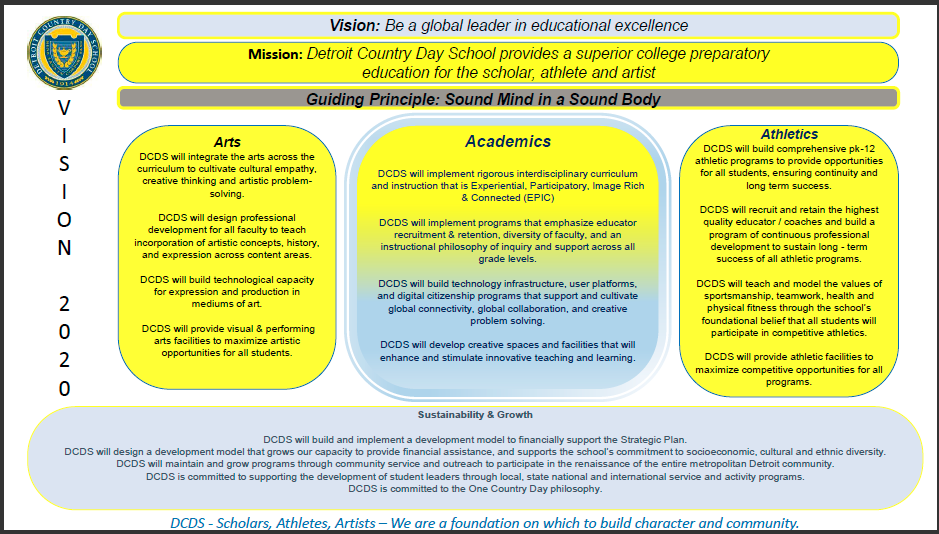
Vision 2020

Ralph Waldo Emerson once wrote that "People only see what they are prepared to see". Preparing our students to "see" in the future requires tremendous forethought and preparation. Detroit Country Day School has been engaged in a nearly year long process to develop the Strategic Plan that will guide the school through the next seven years. The mission of the Strategic Planning process has been to create a blueprint for the success of the school and our school's future for the next seven years and beyond, and has included input from all faculty, staff, administration, and from students and parents as well.

Two weeks ago, our Board of Trustees adopted the overarching one page Strategic Plan, Vision 2020. This one page document provides the philosophical underpinnings of our school and its future, and identifies our three pillars as Academics, Athletics and the Arts, with a foundation of Character as the base for all we do. Now that this document has been approved, our various constituent groups are working on the specific action plans that fall under each goal statement. These action plans are intended to be specific, actionable items with a pre-determined metric for success.

We are excited about the direction developed through the Strategic Planning Process, and look forward to the development of action plans to bring this comprehensive plan to reality.


Monday, November 4, 2013

The Middle of the Race

This weekend members of our cross-country team ran at the State Finals. Coach Winter asked me to address the team Friday, which I was happy to do. Among my many coaching experiences, I spent ten years coaching track and field. One of the things I always stressed to my athletes was running the middle of the race with a special intensity. Most runners can start with energy, and when the finish line is in sight, most can finish hard. Many, many races are won (and lost) in the middle.
 
As I told the kids, a great analogy is the school year. At the beginning of the year, everyone excitedly shops for the special school supplies that are going to keep them organized and on top of their classes. That special Trapper Keeper, the new laptop or tablet, the color coded notebooks and pens - all start to go by the wayside for many students when we enter the fourth or fifth week of school. Then, at the end of a grading period, every student puts on a frantic finish. They cram at the end of the goal or marking period, beg for extra credit, and try to squeeze every last point out of their teachers. Almost everyone starts well and finishes hard, it's the time in between that defines success.
 
As we reach the end of this year's first goal, it's a good reminder that we are entering the "middle" of this school year's "race". Now is the time for students to bear down, make an extra effort, and really become engaged in what is happening in each of their classes. Often, the race is won in the middle...

Tuesday, September 24, 2013

2020 Vision

Historically, predicting the future of education in America has been pretty simple. Looking into a crystal ball and predicting "more of the same" for the schooling of children in this country would have been a pretty safe, and pretty lucrative, way to make a living over time. Nevertheless, we are now in a time of unprecedented change in the way instruction is being delivered, and in the ways in which it will be delivered in the future. Detroit Country Day School will be a leading voice in shaping the best practices in the educational future of our country and the world.
 
During the 2012/2013 school year, DCDS began laying the groundwork for building a new Strategic Plan for all aspects of the school's future. We started with the surveying of faculty and staff, then students and parents, and finally kicked off Strategic Planning in the fall with back to school meetings that involved members of the Board of Trustees, our school administration, and all faculty and staff. Our goal is to create a vision and a plan for the execution of that vision that will carry us through the year 2020. The working vision statement is to "Be the globally recognized leader in innovative educational excellence", and various stakeholder groups of the school are working together to build the plan that will support that vision.
 
During a lunch meeting today, members of the board, our Headmaster, the leadership of each academic division of the school, and the teacher members of the Curriculum Leadership Council (CLC) met to discuss our plans and goals for the academic pillar of our school. The level of engagement demonstrated by our board, administration, faculty and staff has been tremendous in the planning process, and today was no exception. As we worked to build a vision of what our school will be in the year 2020 and beyond, it was immediately clear that the schools of tomorrow will not closely resemble the schools of yesterday. DCDS will be a leader in shaping the new future of education in the world.
 
More than ever in the history of the world, we must prepare our students to be global citizens. The world is more connected, or "flatter", than ever, and preparing students to be productive citizens of such a world presents unique challenges. We must prepare students to creatively solve problems which we cannot yet imagine. We must prepare students to not only use technology, but to build and create new technologies. We mustn't lose sight of our obligation to one another as humans, and to our planet, and sustainability of our resources - both human and otherwise, will be of critical importance. Our 2020 Vision is for a school that does all those things and more, without compromising the values and traditions that make Country Day unique.
 
The soothsayer looks into the future to see what will happen to us, the visionaries look into the future to shape it. At DCDS our goal is to build an innovative instructional environment that maintains traditional values. Traditional values and innovative instructional excellence will shape a new model for delivering instruction that will sustain our school, our nation and the world. That's having "20/20" vision...

Monday, September 9, 2013

Diversity, shmersity....we're all the same???

The first thing that struck me as really unique about Detroit Country Day School was the amazing diversity of the student population. On my first visit to the school I was fascinated not only by the many different cultures and ethnicities represented, but by the seamless integration of students of different religious and cultural backgrounds. Although we sometimes refer to ourselves as being in the protective "bubble" of DCDS, in reality our students have an opportunity to experience the world as it is outside the protective confines of our school - a melting pot of religions, cultures, ideas and world views. Given all of this, I was interested recently while meeting with a DCDS alum who told me that really all of our students have one thing in common.

While our school is sometimes thought of as the "athletics" school, the "arts" school, or as the "math and science" school, when I was having lunch with our art department and DCDS alum Jeremy Sasson ('03), he told us that really all of our kids are the same in one way - someone in their life cares deeply about their education, and cares enough to make sure they have access to Country Day. That idea really resonated with me, as I see the commitment our famlies make to this school. While our students come from different places, different economic circumstances, and different world views, the one thing they do have in common is that someone in their lives cared enough to support them attending this amazing school. Unfortunately, not all young people in our country or the world can say that they have an influence in their life willing to make that kind of commitment. Aside from their own drive and aptitude, and the resources of this school, perhaps the most important ingredient to the success of our students is the support they get that allows them to attend DCDS.

In a world where we often focus on what makes us different, it's refreshing to search for those things we have in common. At least at DCDS, it's a great reminder that despite our superficial differences, a fundamental similarity is the belief in the power a quality education has to influence the course of lives.

Thursday, August 1, 2013

Virtual Desktop

Years ago Detroit Country Day School was one of the first schools in the state and the nation to introduce a “1:1” laptop program that required every student to have a laptop to access the internet, to create original work, and to facilitate student use of proprietary software programs that were part of our curriculum. We are proud to announce that for the 2013-2014 school year, DCDS is again leading the way in technology innovation with the next iteration of that program, our new “Bring Your Own Device” (BYOD) program utilizing a virtual desktop will provide greater freedom of choice for students and families, give greater accessibility to DCDS email and file storage, and effectively transform a wide variety of devices into tools that can be used to facilitate student learning.

This school year, the DCDS technology committee studied our laptop program and a variety of options and developing technology delivery systems. A few themes emerged as important to our faculty, students and families – efficiency, cost effectiveness, flexibility, and access. Our technology committee has unanimously endorsed the virtual desktop concept that effectively allows almost any device that accesses the internet to have the full functionality of a high powered laptop by accessing our virtual desktop. The virtual desktop is in the form of an icon that will be installed on student devices. When clicked on, the virtual desktop opens, giving the student full access to all programs and online resources necessary for DCDS students. The virtual desktop includes the entire Microsoft Office suite of applications, various proprietary software used by our faculty in their courses, full online access via our wireless internet, allows for remote access of all DCDS files saved on our server by students, and is fully protected by our firewalls and security systems.

The virtual desktop allows students to truly “Bring Their Own Devices”. Students can choose the device and platform that best suits them. There is no need for the purchase of expensive software suites, as DCDS has purchased licensing for that software through our virtual desktop. During our trials, we tested various laptops and tablets. For example, we tested our current laptops, and new devices such as the Microsoft Surface tablet, the ipad and ipad mini, and the Google Chromebook. All performed seamlessly with the virtual desktop application, and the virtual desktop gives greater functionality to these devices. For example, although ipads do not support Flash video in normal configuration, when a user accesses our virtual desktop via an ipad, because they are using a platform provided by our servers, while in the virtual desktop application, ipad users can access Flash video. Students who have recently purchased a laptop or new device need not purchase anything else – the virtual desktop can be installed on those devices by our help desk.

The bottom line is that beginning with the 2013-2014 school year, students may choose the device or laptop that best fits their needs as a user. All devices will print on our network, and all of these devices will run the necessary programs needed for students at DCDS as long as the device is connected to the internet. The only requirements of the school are that devices have at least a 7” screen, and include a keyboard (either touch screen or actual). While tablets such as the Surface and the ipad and ipad mini are certainly usable with the virtual desktop, we encourage that students and families experience these devices before deciding on them as typing on these devices is definitely different than typing on a laptop keyboard. Once a device has been purchased, simply contact the DCDS help desk for an appointment to install the virtual desktop.

“BYOD” initiatives represent a real trend in technology use in businesses and universities. This approach allows DCDS families to customize their device choices and purchases based on what fits each student’s needs and each family’s financial circumstances. Effectively the virtual desktop has the capacity to turn an inexpensive device into a high powered laptop. Because the programs will be powered by our school’s servers, and storage will be cloud based provided by DCDS, device speed and storage capacity become less significant issues for school related uses. Students may have needs outside of school for various interests and activities, and those should be taken into account with any device purchase.

Please access the portal for information about the virtual desktop program, including devices we know will work seamlessly. If you have any questions regarding the virtual desktop BYOD program, please contact Network Engineer Matt Nelson at matt.nelson@dcds.edu, or me at Tim.Bearden@dcds.edu . We are very excited about this new era of the 1:1 student to device program at Detroit Country Day School, and believe it gives our students and families yet another advantage as a member of the DCDS family.

Thursday, April 18, 2013

Twitter and Tweets...

Recently we have received reports from students regarding Twitter accounts that have been anonymously created, and used to publish disparaging and / or offensive "tweets" (online messages of 140 characters or fewer) relative to students and other members of the DCDS community.
 
If you are unfamiliar with Twitter, it is an online social media application that in some surveys is beginning to rival Facebook for popularity amongst teens. Social media sites such as Facebook, Twitter , and LinkedIn (a kind of business version of Facebook) have exploded in popularity and variety in recent years. These platforms allow for amazing global connectivity, and offer varied and impressive for potential use in schools, business and social interaction. If you have any doubts as to whether the social media phenomenon is here to stay, this short video will be eye-opening.


Nevertheless, there are some inherent problems associated with social media. One of the issues facing schools is the problem of cyber-bullying. In our society it is becoming increasingly common for teens to hide behind the anonymity of their computer, table or phone and post unkind things about their peers. Unfortunately, this phenomenon is not unique to teens, but it has caused a difficulty for schools as we try to maintain safe, nurturing environments for students. Cyber-bullying hurts in the same ways that other forms of bullying affect students, but has the added component of a very public platform.
 
We have a Pk-12 technology committee addressing proactive steps that we do and can take, and other steps that we might be able to take in the future to educate students, faculty, staff and parents regarding social media. In the meantime, we are requesting your assistance in speaking with your children regarding their online profiles and activities, and emphasizing to them appropriate online language, etiquette, and kindness to others. If you or your children have any information regarding online accounts set up anonymously for the purpose of bullying or other inappropriate behavior, we would appreciate your assistance in sharing that information with us so that we can work to eliminate such issues.
 
For more information on Twitter, and how it works, please visit the following link to an education.com article for parents that gives good information and suggestions : http://www.education.com/magazine/article/parents-guide-to-twitter .

Saturday, April 6, 2013

Admission

My wife and I recently saw the new Tina Fey and Paul Rudd movie Admission. While this blog is certainly not intended for movie reviewing, it is an enjoyable, if not Oscar worthy, film. More pertinently, many parents, educators and students will see themselves or their institutions in certain scenes from the movie, which centers around a Princeton admissions officer's interaction with a student to whom she may have a personal connection.

As we are closing out a very successful college admissions cycle, which saw our students achieve the goals they set for themselves in terms of college opportunities, we have students choosing schedules for next school year. Central to their choices is concern over which scheduling decisions might have the most positive impact on their college admissions applications. Our College Counseling department has a great philosophy - "College is a match to be made, not a prize to be won". If students and parents approach scheduling with this philosophy in mind, it will be hard to misstep.

Like all things in life, a student's schedule should have balance. There should be challenges and opportunities to grow, areas of passion and interest, diversity in content, and a place to have fun. We are often asked whether it is better for a student to receive a "B" in an Honors or AP course or an "A" in a regular course. There is not a universal right answer to this question. Much depends on the student's schedule and personal goals. Nevertheless, the one answer that might fit all these situations is that the student should choose based on what he or she will learn and experience in the course - not an anticipated grade.

In the movie Admission one of the main characters is a high school student who is a voracious reader who receives "5's" on multiple AP tests without taking the course. He is a self-described didactic with incredible ability and insight, but a poor high school record. The debate over his admission plays out on screen, and while there is little doubt the young man has the ability to succeed anywhere, there is question over how he will adapt to an environment like Princeton. That is at the crux of every college decision - whether a university is the right match for an individual student's skills, preparation, personality, and career aspirations. Rarely is that decision made based on a course selection, but rather on the balance of a student's record.

College - A match to be made, not a prize to be won....


Saturday, February 23, 2013

"Authentic" Assessments...

Historically educators have been very isolated. The nature of traditional school day schedules leaves little time for teachers to talk with one another about their practices and to learn from one another. In recent years, many schools have turned to what have been termed "Professional Learning Communities" (PLCs) to give teachers more opportunity to work collaboratively and develop strategies to impact student achievement. This practice has proven successful in many iterations, and in fact we employ it at Country Day. More recently schools have adopted the concept of professional "rounds" that is common in medical professions. In this concept, teachers make visits to one another's classrooms to learn how others implement curriculum, and to open collegial conversations. This practice gives teachers the kind of big picture look at their school which has historically been reserved for administrators who are often not teaching any longer. It is during my own "rounds" in our schools that I gain the greatest insights into what is happening in classrooms.

One of the educational buzz terms these days is "authentic" assessments. The concept is essentially that students be able to demonstrate application skills that require authentic uses of their knowledge as opposed to artificial assessments that require cold memorization and regurgitation of facts. In recent rounds at our Upper School, I have observed many wonderful examples of authentic assessments that engage students in high level critical thinking:

* In a recent visit to an English classroom I observed a faculty member using students' propensity for "tweeting" in tightly worded blurbs. He required students to find succinct "tweet" length statements that summarized key components of a complex piece of literature. This approach resulted in students using an economy of words for a good purpose, and put the assignment in a context that resonated with students and the way they often communicate. The instructor implicitly and explicitly made the point that sometimes an economy of word choice has real "authentic" usefulness, and students were forced to think clearly to meet the requirements.

* In a visit to an AP Government classroom I observed a teacher using an interactive website to teach students re-districting. Each student brought their mobile device to class, logged into the site, and was given a complex set of instructions to re-district a hypothetical geographic area to benefit their hypothetical political party. The game was played as a competition, and students applied skills they had learned in class to an authentic exercise.

* In a recent visit to a 4th grade classroom, I observed students constructing a tee pee out of raw materials in a way similar to characters in a story they read had done. This exercise gave the students a real understanding of the complexity of the task.

"Authentic" assessments require students to use that which they have learned in real and meaningful ways. Sometimes parents, teachers, and even students, feel that assessments have to be stapled, multi-page "events" in order to give an accurate perception of student knowledge. The truth is that sometimes that approach is appropriate, and other times not. If we're being honest with ourselves, the tests that we "crammed" for and successfully passed by regurgitating information often did not result in lasting understanding of content. On the other hand, circumstances that required the application of knowledge to new and unfamiliar problems stay with us because the assessment is itself a learning experience.

As we continue our work towards a more exploratory, project based program of curriculum and instruction, part of our task will be to develop authentic ways to assess student learning. Putting that theory into practice, instructional rounds allow teachers to develop their own skills by analyzing the approaches of others and comparing and contrasting them to their own.

Tuesday, February 5, 2013

Pep Talk from Kid President

All of us can use a pep talk every now and then, and I think we can all agree that pep talks from kids can be special - this one is no exception. One of our teachers / directors sent me this great video - hope you enjoy., and watch all the way to the end!


Not cool Robert Frost....

Wednesday, January 30, 2013

Winds of Change, School in the Mirror

One of the most distinctive features of independent schools should be the ability to change, and to lead education into new and exciting frontiers. One might ask why, then, that so many independent schools operate in much the same way they did thirty, forty, or even more years ago. Public school education changes at a rate roughly equivalent to the time it takes to turn a lump of coal into a diamond - an issue that is often not the fault of the educators who are at the mercy of bureaucracies that do not impact independent schools. The reasons behind independent schools not changing are more complex - partly human nature, partly the limitations that success sometimes put on our imaginations.

I read recently that married people weigh on average about 15 percent more than their single counterparts of the same age. Speculation of the author was that marriage and its familiarity breeds complacency. The same might be said of schools that experience some success and establish familiar patterns. The familiarity of those patterns, and the comfort of that past success can dangerously obscure visions of positive change. A few years ago, author Jim Collins famously wrote that " Good is the enemy of great...". So often that truism can be applied to schools which rely on past successes to the extent that they become barriers to positive, meaningful improvement.

In order to change, the overweight married couple needs to first look in a mirror to recognize that they may have let heir bodies go a little bit. A few more cookies at Christmas, a few too many fast food meals, and too few hours in the gym, and complacency begets an unflattering result. The same is true of schools - we must constantly subject ourselves to honest looks in the mirror. Self- reflection distinguishes good schools from great. 

At Country Day we are going through a virtual fun house of mirrors right now, examining our school from many angles. We are undergoing a curriculum alignment we have called " Five in, Five out" designed to vertically and horizontally align our curriculum by identifying five essential skills a student needs to be successful to begin a course or grade level content area, and five essential skills students should possess on exit from a course or grade level. In this way we are connecting our whole school curriculum, pk-12. In addition we are going through a peer evaluation by the Independent School Association of Central States (ISACS) which has caused us to look at all of our practices, and which will result in a peer report that evaluates our school. We have just closed an engagement survey of our faculty and staff to identify strengths and opportunities in our school community, and are in the process of developing our new teacher evaluation model. In short, we are putting every aspect of our school in front of the mirror, and examining for flaws. Most of our bodies could not hold up to that level of scrutiny...

DCDS intends to continue to be a leader not only in the independent school world, but in a continuous effort to be at the cutting edge of educational best practice. That kind of commitment requires constant self- reflection, and visionary approaches to stave off complacency. We are up to the challenge - just takes a little looking in the mirror...

Wednesday, January 23, 2013

Wigwams, Occam's Razor, and Things We Learn from Kindergarten

Last week I visited a wigwam made by 4th graders, and a tinker toy village, before later visiting a Theory of Knowledge classroom of Upper School students try to stump one another on the topic of Occam's Razor in a review competition. In my dual role as Upper School Head, and PK - 12 Chief Academic officer, I get the pleasure of visiting classrooms across the learning spectrum. The opportunity to see where kids start, and to what heights they grow, and to see it in the same day is a powerful way to develop a picture of a school's curriculum coming to life. As students progress through grade levels and content areas, and mature to more sophisticated concepts, a truism is that levels of student engagement often drop considerably. Crawling in and out of a wigwam can seem like a lot more fun that logarithms, slope, or Puritan literature. It's a good reminder to all of us that some of the principles of elementary education can apply to keeping student engagment levels high at the upper grades.

Blogger Doug Johnson posted recently on maintaining student engagement levels. He created Everything I Know about Engagement I Learned in Kindergarten:
 
In kindergarten we get:
1. Show and tell. You got to do something or bring something and then tell others about it. Secondary skill attainment measurement needs to be less about testing and more about show and tell performance-based assessment. Oh, and listening to other students is a lot more involving than listening to the old person in the room.
2. Choices. As a little kid you often got to choose - your library book, your reading buddy, your activity, the subject of your drawing. People tend to choose things that interest them and interesting things are engaging. How often do we let older students choose?
3. Play. Elementary teachers can make a game out of almost anything - and make just about every task feel like play. The older we get, the less we get to play and more we have to work. Just why is that? Gamification is a fancy term for putting play back into the curriculum. Look it up.
4. Naps. Most adolescents I know are tired - and not because they've been up all night texting. (Well, maybe that's part of it.) We've long known that teens do better when school starts later in the morning. Tired people have a tough time staying engaged.
5. To go outside. The best learning takes place in the "real world" not in the classroom. Whether it is studying bugs and leaves in first grade, marching with the band in junior high, or doing service learning as seniors, we all are more interested when it is the real world with which we are dealing.
6. Colors. A blank sheet of construction paper and some crayolas have always let young learners be creative. Creativity is inherently engaging. What's the high school classroom's equivilant to scissors and paste?
7. To do it together. Reading groups. Play groups. Science groups. It's better with other kids. Social learners are engaged learners.
8. Reading for enjoyment. Our elementary teachers and librarians want us to practice reading so much they let us read what we like! Do our secondary teachers want us to write so much, know so much, experiment so much, and solve problems so much that we get to do it for enjoyment?
9. Learning that's important. Nobody needs to convince a little kid that learning to read, to add and subtract, or to know about firemen is important. And that you should pay attention when being taught these things. Calculus, world history, the Romantic poets, the atomic structure of non-metals, not so much. If you can't convince me what you are teaching should be important to me, teach something that is.
10. Care. OK, this should have been the first one. I really believe a lot little kids are engaged because they know someone cares that they are. Yeah, the littles are cute and cuddly and all that, but the gangly, awkward, homely teens need to know adults care too. When someone else is paying attention to you, you pay more attention yourself.
 
All teachers, at all levels, have a responsibility to develop engaging lessons that make classroom learning relevant. It's a legitimate question for students to ask what relevance content will have to them beyond school. In an engaging classroom that follows the rules of kindergarten, that questions is rarely asked because the answers are obvious. This challenge grows with the sophistication of material, but these rules of kindergarten are great reminders for parents and teachers alike that learning can, and should be, stimulating, engaging, and fun.


Friday, January 11, 2013

Never Work Harder Than Your Students

In Never Work Harder than Your Students, author Robyn Jackson defines a master teacher as one who follows seven principles:
 
1.       Start where your students are.
2.       Know where your students are going.
3.       Expect to get your students to their goal.
4.       Support your students along the way.
5.       Use frequent and thoughtful feedback to help you and your students get better.
6.       Focus on quality rather than quantity.
7.       Never work harder than your students.
 
To the last point, Jackson argues that teachers commonly do all the work in planning and delivering lessons, assessing the lessons, and dictating the learning (Jackson, p.172).  Jackson further argues that swinging to a completely “student centered” classroom is not the answer to this problem, but rather suggests that the classroom should be a community that should establish a balance between the roles of teacher and student in the learning process. It’s an interesting proposition to consider how much of the responsibility in the learning process falls on the shoulders of the classroom teacher. Teachers who lecture exclusively, or provide the questions or the variables a student must answer to solve complex problems may be shouldering more of the load than necessary or appropriate. Teaching students to ask the right questions is a critical element of the journey.
 
I once evaluated an English teacher who assigned two portions to every assessment. For part I, he required students to write questions for the test that they thought would force one another to think at complex / application levels. He then graded students on their questions for part I of their assessment grade. Part II of their grade was completing an assessment made up of entirely student written questions from Part I. I’ve always thought it was a brilliant model – one of the most important skills a student can learn, is what questions to ask. I’d be willing to bet that each of you can remember times when you or someone you knew studied long hours for an assessment and did poorly because you didn’t study the material that the teacher thought was important enough to be on the assessment. Conversely, you can probably think of times when you studied the right material for a relatively short time, and did much better than students who studied longer, but studied non-critical material. Cultivating the skill of asking questions is critical, and the questions students ask will reveal much about their understanding of content.

Friday, December 21, 2012

Good to Great, Great to Greater

Author Jim Collins, in his book Good to Great, writes "Good is the enemy of great....we don't have great schools primarily because we have good schools." His point is that schools, and most organizations, that reach a level of proficiency become complacent and don't move beyond good. They stop reflecting on their practices, and do things the way they've always done them because these practices have proven over time to be good. Country Day School is a school that is great already in most respects, but we're committed to being "greater" in every way possible.
 
One of the initiatives we've undertaken this year is a horizontal and vertical integration of our curriculum. We have used a process we are calling "5 in / 5 out" as the vehicle for aligning our curriculum. The goal is to identify the five essential skills for a student coming into a content area by course or grade level, and the five essential skills or pieces of content knowledge with which a successful student will leave. In this way, we will link together all courses, content areas, and grade levels in the school, pk-12. We will also have a mechanism for eliminating unnecessary redundancies, and filling gaps that we discover exist. Through this process, teachers are meeting not only with their departmental or grade level colleagues, but also with teachers whose courses or grade levels come before and after them in the vertical path towards graduation. We have undertaken this endeavor not because we necessarily feel there are issues with our current curriculum, but so we can open dialogue between faculty at all levels, evaluate our own practices, and look for ways to make a great school even greater.
 
By the end of this school year, we anticipate that we will have completed our curriculum alignment, and will shift our efforts to discussion of "how we teach" rather than "what we teach". In this ongoing evaluation of curriculum and practice, we hope to establish strong connections across grade levels, and really develop the "One Country Day" concept of shared and collegial collaboration. One of the foundations of Detroit Country Day School is a commitment to excellence, and part of that commitment is consistent, ongoing self-reflection and evaluation. To paraphrase Thomas Edison, "If there's a way to do it better - find it."
Happy Holidays to all of our Country Day families. We wish you a happy and healthy holidays season and New Year.

Wednesday, December 12, 2012

Parent / Teacher Communication

"When I was a boy of 14, my father was so ignorant I could hardly stand to have the old man around. But when I got to be 21, I was astonished at how much the old man had learned in seven years." -  Mark Twain
 
I've always loved this quote attributed to Twain, as it so aptly describes the evolution we go through in our perceptions of our parents. Young people, particularly adolescents, often fail to appreciate the wisdom and knowledge that comes from their parents. This youthful perception is sometimes extended to all adults, including their teachers.  As both teachers and parents must deal with the commonly held adolescent belief that all adults are clueless, it can be hugely important to join forces in a positive way in the best interests of students. One of the most successful approaches is when parents and teachers knowingly work together to ensure student responsibility and accountability. Putting the responsibility on young people to handle issues with their teachers teaches them valuable coping lessons that will serve them in future issues that require self-reliance. Nevertheless, not all of a student's issues can be solved by the meeting of student and teacher, and the partnership of parents and teachers becomes essential.
 
I am sometimes asked by parents the proper protocol, and best steps to take in communicating with teachers. Parents sometimes worry that if they voice a concern there will be reprisals for their child. Our teachers are professionals, who are in this profession because of their commitment to young people and their growth, and mutual understanding and trust between parent and teacher can resolve most issues. Please consider the following protocol for optimal resolution of issues:
 
DCDS Problem Solving Protocol
  1. Student addresses issue with teacher in a private, personal appointment. This will result in successful outcome in the majority of circumstances.
  2. If student and teacher cannot resolve issue, parent makes email or phone contact with the teacher or the student's advisor who can often assist in facilitating a solution. If the situation is emotionally charged, it is recommended that this communication be solely for the purpose of arranging a personal meeting between parent and teacher. Many situations can be resolved by email or phone.
  3. Personal meeting between parent and teacher - depending on the circumstances, it may be important to also include the student.
  4. If a personal meeting with the teacher occurs, and the issue has still not been resolved satisfactorily,  the next step for parents should be contact with the relevant department chair, dean, or school director. Administrative assistance should be an avenue for resolution that occurs after other steps have been exhausted.
Tips, and Potential Pitfalls to Avoid:
  1. Teachers appreciate students who advocate for themselves. That being said, private conversations that are pre-arranged are almost always better than a public or classroom conversation.
  2. A cooling off period is almost always beneficial for all. If the situation is emotionally charged, follow the 24 hour rule, and allow for some time to pass so that cool heads can resolve issues.
  3. Email can be dangerous for resolving complex issues, as many nuances of communication are lost in these impersonal written communications. Email can be very effective for getting information, communicating absences, arranging appointments and other surface communications. It is advisable not to rely on email for exchanges of a more personal nature. If you are unsure as to whether an email is appropriate for a situation, err on the side of a personal meeting.
  4. It is not appropriate or constructive to confront a teacher or administrator about personal student matters in public spaces, or without an appointment. In emergency situations, always visit the academic office first for communication with an administrator who will help facilitate problem solving measures.
  5. Successful resolutions do not result from threatening language or behavior. Even if it may not seem so at the time, educators try their best to work in the interest of all students, and are generally compassionate and caring towards young people. If you find it difficult to maintain composure because of the tenor of a meeting, involve an administrator to facilitate or take a cooling off period.
Our teachers, administration and staff are here for you and your children. We want the best possible experience for them, and working together with parents in a positive and constructive way to present a unified team approach to students reinforces the important roles of both school and family. It may even result in students who someday recognize our "growth" in knowledge and intelligence as they gain a more global, adult perspective of the motives of parent and school.
 
If you have any questions about appropriate school contacts and , or strategies to resolve conflicts, please don't hesitate to contact me at Tbearden@dcds.edu, or by phone at 248.430.3696.

Friday, December 7, 2012

Welcome

Welcome to The Principal's Office, a blog created by Tim Bearden, Chief Academic Officer and Director of the Upper School at Detroit Country Day School.

The purpose of this blog is not only to provide information and updates relevant to the DCDS school community, but to explore concepts, ideas, programs and directions germane to 21st century schools, and the creativity and innovation that will be necessary to best serve students of this next generation.

This blog is a continuation of the blog The Principal's Office first started at Grosse Pointe North High School. Some of the posts from that blog which have relevance to educational issues in general, and are not specific to North, have been retained as part of this new iteration.

As always, comments are encouraged and welcomed, and thanks for visiting The Principal's Office.

Monday, November 12, 2012

EPIC Instruction

At the beginning of this school year we had an inservice for staff designed to look at different ways to deliver instruction built around a theme that instruction for today's generation of students has to be "EPIC". EPIC is an acronym coined by Tim Elmore for instruction that is Experiential, Participatory, Image Rich and Connected. EPIC instruction certainly looks different than traditional lecture delivery, and it feels different for students and teachers alike. Our approach of evolving to a project based model of instruction is built on the platform of EPIC instructional delivery.

Well-known New York educator Pedro Noguera has often said, "I can spend all day teaching my dog Spanish - that doesn't mean that at the end of the day he can speak it". For years education has been built on the instructional delivery model of teachers lecturing, students taking notes, and subsequently "regurgitating" the information. One need go no further than personal experience to evaluate whether that model led to long term retention...in my case I can say unequivocally that I no longer remember much of what I "learned" during my college experience (and no, it's not because of the number of years that have passed...).

More recent research is clear that retention and "learning" is based largely on experience. Few of us learn by having someone tell us information. EPIC instruction is based on the premise that students must experience and participate in the learning and the delivery of learning, and that the role of the teacher must transform into one of "guide on the side" vs. "sage on the stage".

This article details that transformation through the lens of experiences of a college physics instructor. As I visit the classrooms of our building, I can say with a high degree of certainty that EPIC instruction works, it's more engaging, and develops a deeper understanding of material.

Physicists Seek To Lose The Lecture As Teaching Tool
by Emily Hanford

January 1, 2012

Listen to the Story
All Things Considered
[7 min 50 sec] Add to Playlist
Download
Transcript
text size A A A January 1, 2012 from APM The lecture is one of the oldest forms of education there is.

"Before printing someone would read the books to everybody who would copy them down," says Joe Redish, a physics professor at the University of Maryland.

But lecturing has never been an effective teaching technique and now that information is everywhere, some say it's a waste of time. Indeed, physicists have the data to prove it.

When Eric Mazur began teaching physics at Harvard, he started out teaching the same way he had been taught.

"I sort of projected my own experience, my own vision of learning and teaching — which is what my instructors had done to me. So I lectured," he says.

He loved to lecture. Mazur's students apparently loved it, too. They gave him great evaluations and his classes were full.

"For a long while, I thought I was doing a really, really good job," he says.

But then in 1990, he came across articles written by David Hestenes, a physicist at Arizona State. Hestenes got the idea for the series when a colleague came to him with a problem. The students in his introductory physics courses were not doing well: Semester after semester, the class average never got above about 40 percent.

"I noted that the reason for that was that his examination questions were mostly qualitative, requiring understanding of the concepts rather than just calculational, using formulas, which is what most of the instructors did," Hestenes says.

Hestenes had a suspicion students were just memorizing the formulas and never really getting the concepts. So he and a colleague developed a test to look at students' conceptual understanding of physics. It's a test Maryland's Redish has given his students many times.

Here's a question from the test: "Two balls are the same size but one weighs twice as much as the other. The balls are dropped from the top of a two-story building at the same instant of time. The time it takes the ball to reach the ground will be..."

The possible answers include about half as long for the heavier ball, about half as long for the lighter ball, or the same time for both. This is a fundamental concept but even some people who've taken physics get this question wrong.

To get to the answer, Redish went to the second floor of the physics building. A group of his students was on the sidewalk below. When he reached the top, he dropped two balls from the roof.

The two balls reached the ground at the same time. Sir Isaac Newton was the first person who figured out why. He came up with a law of motion to explain how two balls of different weights, dropped from the same height, hit the ground simultaneously.

While most physics students can recite Newton's second law of motion, Harvard's Mazur says, the conceptual test developed by Hestenes showed that after an entire semester they understood only about 14 percent more about the fundamental concepts of physics. When Mazur read the results, he shook his head in disbelief. The test covered such basic material.

"I gave it to my students only to discover that they didn't do much better," he says.

The test has now been given to tens of thousands of students around the world and the results are virtually the same everywhere. The traditional lecture-based physics course produces little or no change in most students' fundamental understanding of how the physical world works.

"The classes only seem to be really working for about 10 percent of the students," Arizona State's Hestenes says. "And I maintain, I think all the evidence indicates, that these 10 percent are the students that would learn it even without the instructor. They essentially learn it on their own."

He says that listening to someone talk is not an effective way to learn any subject.

"Students have to be active in developing their knowledge," he says. "They can't passively assimilate it."

This is something many people have known intuitively for a long time — the physicists just came up with the hard data. Their work, along with research by cognitive scientists, provides a compelling case against lecturing. But with budgets shrinking and enrollments booming, large classes aren't going away. You don't have to lecture in a lecture hall though.

Mazur's physics class is now different. Rather than lecturing, he makes his students do most of the talking.

At a recent class, the students — nearly 100 of them — are in small groups discussing a question. Three possible answers to the question are projected on a screen. Before the students start talking with one another, they use a mobile device to vote for their answer. Only 29 percent got it right. After talking for a few minutes, Mazur tells them to answer the question again.

This time, 62 percent of the students get the question right. Next, Mazur leads a discussion about the reasoning behind the answer. The process then begins again with a new question. This is a method Mazur calls "peer Instruction." He now teaches all of his classes this way.

"What we found over now close to 20 years of using this approach is that the learning gains at the end of the semester nearly triple," he says.

One value of this approach is that it can be done with hundreds of students. You don't need small classes to get students active and engaged. Mazur says the key is to get them to do the assigned reading — what he calls the "information-gathering" part of education — before they come to class.

"In class, we work on trying to make sense of the information," Mazur says. "Because if you stop to think about it, that second part is actually the hardest part. And the information transfer, especially now that we live in an information age, is the easiest part."

Mazur's approach is one of many developed in response to evidence that traditional lectures don't work. Among the advocates of these approaches there's an increasing sense of urgency about how to help more students do better.

"We need to educate a population to compete in this global marketplace," says Brian Lukoff, an education researcher at Harvard. "We can't do that by just sort of picking out 10 percent and saying, 'Oh you guys are going to be the successful ones,' and you know we need a much larger swath of that population to be able to think critically and problem-solve."

But ask anyone involved with efforts to lose the lecture and they'll tell you they encounter resistance. Sometimes the stiffest opposition comes from the students.

"Revamping my entire education, you know, philosophy for this one class was a bit daunting," says Ryan Duncan, a sophomore in Mazur's class.

But he adapted and says he learned more in Mazur's class than he did in his other physics course at Harvard.

Maryland's Redish says when he lays out the case against lecturing, colleagues often nod their heads, but insist their lectures work just fine. Redish tells them — lecturing isn't enough anymore.

"With modern technology, if all there is is lectures, we don't need faculty to do it," Redish says. "Get 'em to do it once, put it on the Web, and fire the faculty."

Some faculty are threatened by this, but Mazur says they don't have to be. Instead, they need to realize that their role has changed.

"It used to be just be the 'sage on the stage,' the source of knowledge and information," he says. "We now know that it's not good enough to have a source of information."

Mazur sees himself now as the "guide on the side" – a kind of coach, working to help students understand all the knowledge and information that they have at their fingertips. Mazur says this new role is a more important one.

American Radioworks is the documentary series from American Public Media. You can find more of their reporting on this issue at "Don't Lecture Me."